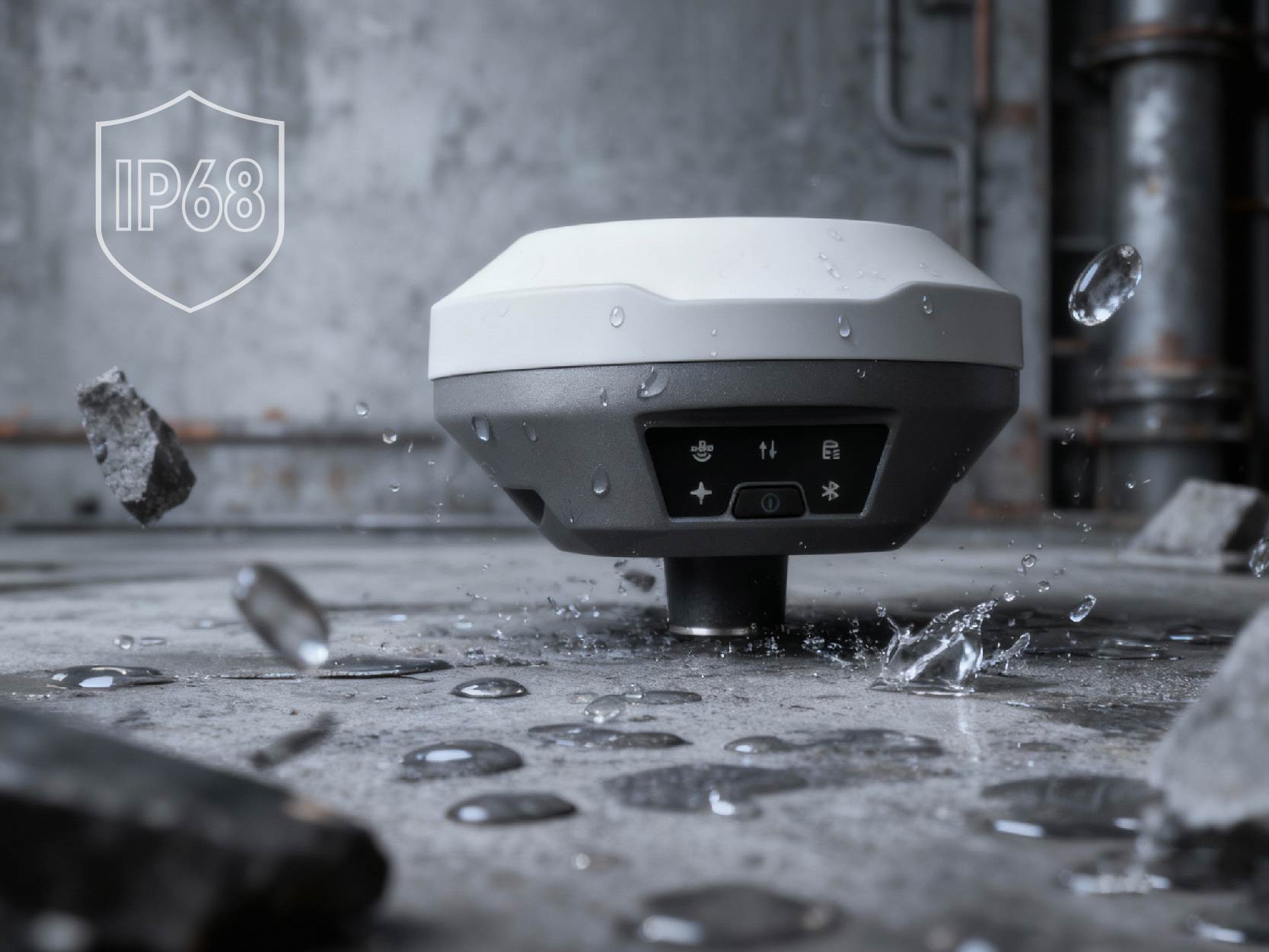
IP68
PPP 2 CM RMS
L1 / L2 / L5
NO CORS NEEDED
L-Base
IP68-rated GNSS receiver with built-in PPP processing. Dust-tight, submersible, field-ready.
Self-converging PPP base station that delivers centimetre-accurate RTK corrections to any GNSS-RTK device — drones, agricultural auto-steer, construction machine control, and survey rovers. Uses commercial L-Band PPP data with 99% availability and dual-satellite coverage worldwide. No CORS subscription needed.
Ongoing costs, limited coverage, infrastructure dependency
Satellite-based, global coverage, no infrastructure
Watch L-Base auto-converge via commercial L-Band PPP corrections with 99% availability and dual-satellite global coverage. Requires open sky to receive L-Band signals. Just place, power on, and work.
Set L-Base on the ground with open sky — clear view of L-Band satellites required. No tripod needed.
Press the button. PPP auto-converges to ITRF2020 centimetre coordinates using commercial L-Band satellite data.
RTK corrections stream to your equipment automatically. 10-hour battery, or plug in USB-C for non-stop operation.

Drones, tractors, graders, survey rovers — L-Base delivers centimetre accuracy where CORS networks don't reach.
Multi-frequency carrier phase eliminates ionospheric delay. Precise orbit & clock corrections resolve ambiguities. Converges in ~5 minutes under open sky.
PPP coordinates locked as base station reference. Generates RTCM 3.x corrections, broadcast as NTRIP stream in real time.
Fly volumetric surveys over mine sites where CORS coverage doesn't exist. L-Base delivers centimetre-accurate corrections from satellite — calculate stockpile volumes with confidence, even at the most remote pit.
Map drainage patterns, plan variable-rate seeding, and verify land boundaries across vast farms. No cellular network needed — L-Base works off-grid in Kazakhstan, Australia, Brazil, or anywhere your fields are.
Monitor earthworks, guide machine control systems, and survey road corridors. L-Base provides RTK corrections for drones, graders, excavators, and survey rovers — without an annual CORS subscription eating your project budget.
| L-Base + PPP | Government CORS | Commercial CORS | Trimble RTX | Self-Built Base | DJI D-RTK 3 | |
|---|---|---|---|---|---|---|
| Technology | PPP via L-Band satellite | Network RTK via NTRIP | Network RTK via NTRIP | PPP via L-Band satellite | Single-base RTK | Network RTK (no PPP) |
| CORS subscription | Not needed | Free (where available) | $500–2,000+/yr | $1,200–2,400/yr | Not needed | Recommended |
| Coverage area | Global — open sky | Near CORS stations only | Near CORS stations only | Global — open sky | ~10 km from base | Near CORS stations |
| Rural / remote | Works everywhere | Major coverage gaps | Gaps in developing regions | Works everywhere | Works everywhere | Depends on CORS |
| Accuracy | 2 cm RMS (PPP+RTK) | 1–2 cm (near station) | 1–2 cm (near station) | 2–4 cm (PPP only) | 1–2 cm (near base) | 1–2 cm (with CORS) |
| Degrades with distance | No — satellite-based | Yes — beyond 30–40 km | Yes — beyond 30–40 km | No — satellite-based | Yes — beyond 10 km | Yes — beyond 30–40 km |
| Internet required | No — radio or 4G | Yes — cellular/internet | Yes — cellular/internet | No — L-Band direct | No — radio link | Yes — for CORS |
| Setup time | ~5 min (auto-converge) | 0 min (connect NTRIP) | 0 min (connect NTRIP) | ~20–30 min converge | 5–15 min (survey base) | ~5 min |
| Coordinate reference | ITRF2020 absolute | Local datum (varies) | Local datum (varies) | ITRF2014 absolute | User-defined / relative | Depends on CORS |
| Repeatable coordinates | Yes — global absolute | Yes (if datum stable) | Yes (if datum stable) | Yes — global absolute | No — base moves each setup | Depends on CORS |
| Compatible devices | Any RTCM 3.x device | Any NTRIP client | Any NTRIP client | Trimble only | Any RTCM 3.x device | DJI drones only |
| Vendor lock-in | None — open platform | None | Provider-dependent | Trimble ecosystem | None | DJI ecosystem |
| Hardware cost | From $2,399 | $0 (use existing rover) | $0 (use existing rover) | Included in receiver | $5,000–15,000 | $1,699+ |
| Annual cost | $999/yr (PPP data) | Free (limited regions) | $500–2,000+/yr | $1,200–2,400+/yr | $0 (but maintenance) | $500–2,000+/yr (CORS) |
| Portability | Pocket-sized, IP68 | N/A (infrastructure) | N/A (infrastructure) | Built into receiver | Heavy tripod + receiver | Portable |
| Power | 10 hr battery + USB-C | N/A | N/A | Receiver battery | External power needed | Battery |
| 3rd-party dependency | PPP data provider | Government uptime | Provider uptime | Trimble servers | Self-maintained | DJI + CORS provider |
We dropped our CORS subscription on day one. L-Base just works — even in areas where we had zero network coverage.
My students use it for thesis fieldwork. Setup takes less time than explaining what CORS is.
The ROI was obvious. One device replaced our base station and our CORS subscription. Paid for itself in three months.
IP68-rated. Dust-tight. Submersible. L-Base is a compact GNSS receiver with built-in PPP processing — eliminating your dependency on CORS networks entirely.
No base station network required. Set up in 5 minutes with open sky, anywhere on Earth.
CORS subscription $1,500/yr × 3
+ base station hardware
Hardware + 1 year PPP included
Year 2-3: $999/yr
Buy the hardware. Subscribe to PPP corrections separately, or bundle and save.
| GNSS Performance | |
|---|---|
| Constellations | GPS, GLONASS, BeiDou, Galileo, QZSS, SBAS |
| Channels | 1792 |
| PPP Accuracy (H/V) | 2 cm RMS (convergence: ~5 min typical, open sky required) |
| RTK Accuracy (H/V) | 0.8 cm + 1 ppm / 1.5 cm + 1 ppm |
| Static Accuracy (H/V) | 2.5 mm + 0.5 ppm / 5 mm + 0.5 ppm |
| Update Rate | Up to 20 Hz |
| TTFF | Cold <30s · Warm <5s · Re-acquisition <1s |
| Tilt Compensation | ≤2 cm (within 60°), calibration-free |
| Communication | |
| Cellular | 4G LTE / WCDMA / GSM (FDD B1/B3/B7/B8/B20/B28, TDD B38/B40) |
| Internal Radio | 410–470 MHz UHF, 0.5W/1.0W (TrimTalk, South, Satel, Transparent) |
| Wi-Fi | 802.11 b/g/n (Hotspot mode) |
| Bluetooth | 4.1 |
| Wired | USB Type-C (OTG supported) |
| Network Protocols | NTRIP Client/Server, TCP |
| System & Data | |
| Operating System | Linux |
| Internal Storage | 8 GB |
| Data Output | RINEX, NMEA-0183 |
| Differential Format | CMR, RTCM 2.x / 3.x |
| Electrical | |
| Battery | 7000 mAh / 7.4V lithium (built-in) |
| Working Time | Up to 10 hours |
| Charging | 15W fast charge (5V 3A), 3 hrs to 90% |
| External Power | USB 5–20V |
| Physical & Environmental | |
| Dimensions | φ132 × 68 mm |
| Weight | ≈ 827 g |
| Operating Temp | -40°C to +70°C |
| Storage Temp | -55°C to +85°C |
| Ingress Protection | IP68 (dust-tight, waterproof) |
| Shock Resistance | 2 m pole drop onto concrete |
| Vibration | MIL-STD-810G |
L-Band PPP (Precise Point Positioning) is a satellite-based correction technology that delivers centimetre-level positioning without any ground infrastructure. Geostationary satellites continuously broadcast precise orbit and clock correction data on the L-Band frequency (around 1.5 GHz), covering entire continents with a single beam. L-Base receives these signals alongside standard GNSS observations from GPS, GLONASS, Galileo, and BeiDou, then runs a PPP algorithm that converges on its true absolute coordinates — typically 2 cm accuracy within about 5 minutes of open-sky operation. Because the correction data comes directly from satellites rather than a terrestrial network, there is no baseline limit, no NTRIP subscription, no internet dependency, and no coverage gap. The result is a self-contained base station that knows exactly where it is on the planet, and can broadcast that knowledge as standard RTCM 3.x corrections to any nearby rover. Traditional RTK requires someone to have already surveyed the base station location or depend on an active CORS network — PPP eliminates both requirements entirely.
RTK (Real-Time Kinematic) is the technique that turns a standard GNSS receiver from metre-level to centimetre-level accuracy. Here is how it works: a base station sitting at a known location receives the same satellite signals as your rover (drone, tractor, survey receiver). Because the base station knows its own coordinates precisely, it can calculate the errors present in the satellite signals at that moment — atmospheric delays, orbit errors, clock drift — and package them into a compact correction message (RTCM 3.x format). This correction is transmitted to the rover via radio link, 4G cellular, or NTRIP internet stream. The rover applies the correction in real time, cancelling out most of the errors and achieving 1–2 cm accuracy. The key requirement is that someone must establish the base station coordinates first. Traditionally this means surveying the point manually, subscribing to a CORS network, or accepting only relative accuracy. L-Base solves this by using PPP to autonomously determine its own absolute coordinates, then generating RTK corrections automatically — giving you the precision of RTK with the global reach of PPP.
Relative accuracy means that all points within a single survey session are precisely positioned relative to each other, but the entire dataset may be offset from its true location on Earth by an unknown amount. This happens whenever you set up a conventional base station and simply let it average its position or assign arbitrary coordinates. Your internal measurements — distances between points, area calculations, elevation differences — will all be excellent (centimetre-level). However, the whole block of data could be sitting 1–3 metres away from where it should actually be in a global coordinate system. The practical consequences are significant: if you return next week and set up the base again, the new offset will be different, so your two datasets will not align. You cannot reliably overlay your data on government cadastral maps, satellite imagery, or other teams' surveys. Merging datasets from different days requires manual post-processing with control points. For many drone mapping and agricultural guidance applications, this hidden shift creates real problems — repeated passes do not line up, and field boundaries drift between sessions.
Absolute accuracy means every point in your survey is positioned correctly within a global reference frame — such as ITRF2020 or WGS84 — reflecting its true location on the surface of the Earth to within a stated tolerance (2 cm in the case of L-Base). This is fundamentally different from relative accuracy because there is no unknown offset. When you survey on Monday and return on Friday, both datasets share the same coordinate system and align perfectly without any adjustment. Your data matches government geodetic control points, integrates seamlessly with cadastral records, overlays accurately on satellite imagery, and merges cleanly with surveys from other teams using any properly georeferenced equipment. L-Base achieves absolute accuracy through PPP: it receives satellite orbit and clock corrections on the L-Band, computes its own global coordinates autonomously, and then broadcasts RTK corrections anchored to those coordinates. No manual coordinate entry, no CORS dependency, no post-processing shifts — just consistent, repeatable, globally referenced centimetre positioning every time you power on.
It sits on the ground and broadcasts RTK corrections to any GNSS-RTK device — drones, agricultural auto-steer systems, construction machine control, or survey rovers. Accurate to 2 centimetres. That means your survey maps, precision ag operations, and machine-guided earthworks come out precise without any extra work.
You can still use GCPs for checkpoints, but L-Base dramatically reduces how many you need. Many users skip them entirely for routine jobs. That alone can save hours per mission.
Nope. Put it on the ground with open sky, press the power button, wait about five minutes. That’s it. No apps to configure, no coordinates to type in. It figures everything out on its own.
Any device that accepts RTCM 3.x corrections: DJI drones (Matrice, Phantom 4 RTK, Mavic 3E), ArduPilot/PX4 builds, agricultural auto-steer (John Deere, CNH, CLAAS via ISOBUS), construction machine control systems, and survey rovers from Emlid, Tersus, and others.
That’s actually where L-Base shines. It has a built-in radio link that works without any internet at all. You can work in the middle of nowhere — mountains, farmland, desert — and still get centimetre accuracy. Just ensure open sky so L-Base can receive L-Band satellite signals.
All day. One charge gets you through a full day of fieldwork. You can also plug in a USB-C power bank if you need longer.
Yes — it’s compact and doesn’t need a tripod. Way more portable than the big base stations you’ve probably seen in surveying courses.
CORS subscriptions cost $500–2,000 a year, don’t work everywhere (especially rural areas), and you’re relying on someone else’s network staying online. L-Base gets the same accuracy from satellites directly, so none of those problems apply.
The bundle is $2,999 for hardware + one year of service. Compare that to a CORS subscription ($500–2,000/yr) plus a traditional base station. For thesis fieldwork or a surveying startup, it pays for itself quickly. There’s also a monthly plan at $99/mo if you only need it seasonally.
Keep working. It’s IP68 rated — fully waterproof and dust-proof. Rain, mud, puddles, no problem.
We survey 40 km of shoreline every quarter to track erosion. Before L-Base, we needed CORS — which meant no coverage on half our sites. Now we set up in five minutes on the beach and fly. The data consistency between repeat surveys is exactly what our coastal engineers need.
Our site is 200 km from the nearest CORS station. Traditional RTK was simply not an option. L-Base gave us centimetre-accurate orthomosaics for panel layout planning — we saved three weeks of ground survey work on a single project.
We inspect hundreds of kilometres of high-voltage lines across remote mountains. Every flight must follow the exact same path — in global absolute coordinates — month after month, year after year. L-Base gives us ITRF2020 positioning wherever we go. No CORS, no convergence headaches. Just set it down, wait five minutes, and launch. The coordinate consistency across repeat missions is what makes this invaluable.
My tractors cover a huge area across multiple farms. I need a base station I can move from field to field, but for the tractor auto-steer it must always be global absolute coordinates — perfectly aligned year after year. With L-Base I just drive to the next field, set it on the ground, and five minutes later my RTK tractor is running. I charge it with any USB-C charger or a portable solar panel, so it runs non-stop all season. No CORS subscription, no coverage gaps, and it connects to every RTK tractor I own.
Fill in the contact form, and we will reply within a working day (9:00–18:00 CST).
Alternatively, you can reach us here:
Satellite-based centimetre positioning for drones, agriculture, construction and survey. No CORS. No lock-in.
Order L-Base